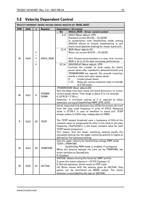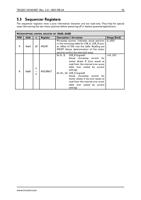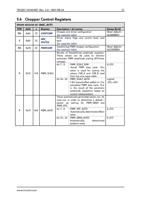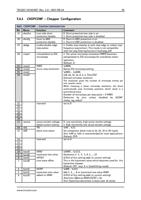







TMC2225 DATASHEET (Rev. 1.15 / 2023-FEB-16)
70
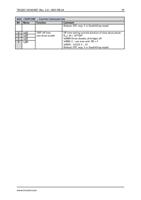
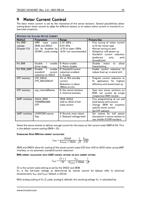
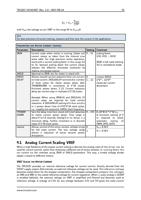
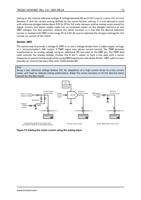
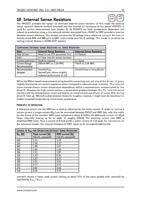
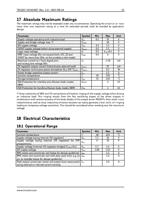
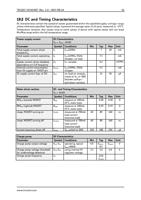
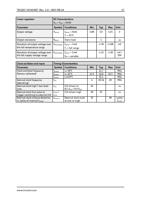
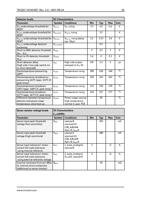
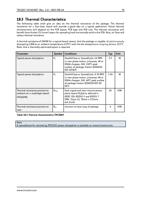
18.3 Thermal Characteristics
The following table shall give an idea on the thermal resistance of the package. The thermal
resistance for a four-layer board will provide a good idea on a typical application. Actual thermal
characteristics will depend on the PCB layout, PCB type and PCB size. The thermal resistance will
benefit from thicker CU (inner) layers for spreading heat horizontally within the PCB. Also, air flow will
reduce thermal resistance.
A thermal resistance of 26K/W for a typical board means, that the package is capable of continuously
dissipating 3.8W at an ambient temperature of 25°C with the die temperature staying below 125°C .
Note, that a thermally optimized layout is required.
Parameter
Typical power dissipation
Typical power dissipation
Thermal resistance junction to
ambient on a multilayer board
HTSSOP28
Thermal resistance junction to
case
Symbol Conditions
PD
StealthChop or SpreadCycle, 1A RMS
in two phase motor, sinewave, 40 or
20kHz chopper, 24V, 110°C peak
surface of package (motor QSH4218-
035-10-027)
PD
StealthChop or SpreadCycle, 0.7A RMS
in two phase motor, sinewave, 40 or
20kHz chopper, 24V, 68°C peak surface
of package (motor QSH4218-035-10-
027)
RTMJA
Dual signal and two internal power
plane board (2s2p) as defined in
JEDEC EIA JESD51-5 and JESD51-7
(FR4, 35µm CU, 70mm x 133mm,
d=1.5mm)
RTJC
Junction to heat slug of package
Table 18.1 Thermal characteristics TMC2225
Typ Unit
2.5
W
1.36 W
26 K/W
6
K/W
Note
A spreadsheet for calculating TMC2225 power dissipation is available on www.trinamic.com.
www.trinamic.com