






TMC2225 DATASHEET (Rev. 1.15 / 2023-FEB-16)
34
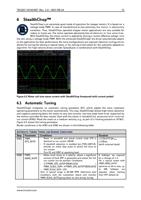
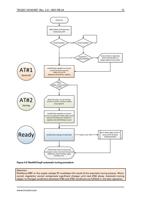
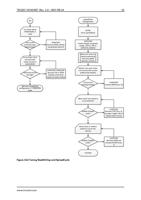
Determine best conditions for automatic tuning with the evaluation board.
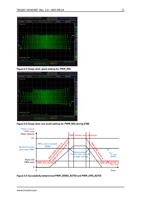
Monitor PWM_SCALE_AUTO going down to zero during the constant velocity phase in AT#2 tuning. This
indicates a successful tuning.
Attention:
Operating in StealthChop without proper tuning can lead to high motor currents during a deceleration
ramp, especially with low resistive motors and fast deceleration settings. Follow the automatic tuning
process and check optimum tuning conditions using the evaluation board. It is recommended to use
an initial value for settings PWM_OFS and PWM_GRAD determined per motor type. Avoid hard st ops
from high velocities, even after tuning StealthChop settings. A deceleration ramp is required in each
case.
When powering up in StealthChop, make sure that the supply voltage ramps to the final voltage.
Powering up to a lower voltage (e.g. 5V) will lead to wrong tuning, in case the motor becomes
enabled at the lower voltage. Alternatively disable the motor during power-up.
Known Limitations:
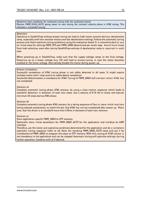
Successful completion of AT#1 tuning phase is not safely detected in all cases. It might require
multiple motor start / stop events to safely detect completion.
Successful determination is mandatory for AT#2: Tuning of PWM_GRAD will not start when AT#1 has
not completed.
Solution a):
Complete automatic tuning phase AT#1 process, by using a slow-motion sequence which leads to
standstill detection in between of each two steps. Use a velocity of 8 (6 Hz) or lower and execute
minimum 10 steps during AT#1 phase.
Solution b):
Complete automatic tuning phase AT#1 process, by a doing sequence of four or more initial motions
(using reduced acceleration, to match the fact that AT#2 has not yet completed) after power up. Make
sure, that the driver is at standstill more than 130ms in between of each two motions.
Solution c):
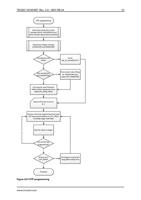
Store application specific PWM_GRAD to OTP memory.
Optionally store initial parameters for PWM_GRAD_AUTO for the application and initialize by UART
interface.
Therefore, use the motor and operating conditions determined for the application and do a complet e
automatic tuning sequence (refer to a)). Note the resulting PWM_GRAD_AUTO value and use it for
initialization of PWM_GRAD or program the value to OTP memory. With this, tuning of AT#2 phase is
not mandatory in the application and can be skipped. Automatic tuning will optimize settings during
further operation. Combine with a) if desired.
www.trinamic.com