






TMC2225 DATASHEET (Rev. 1.15 / 2023-FEB-16)
13
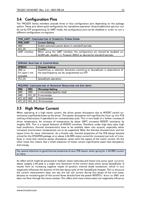
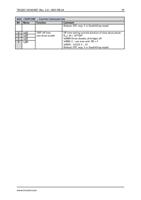
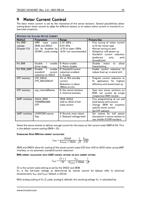
3.4 Configuration Pins
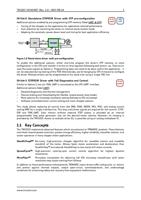
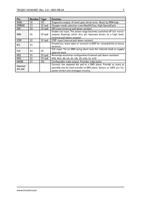
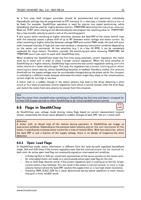
The TMC2225 family members provide three or four configuration pins depending on the package
option. These pins allow quick configuration for standalone operation. Several additional options can
be set by OTP programming. In UART mode, the configuration pins can be disabled in order to set a
different configuration via registers.
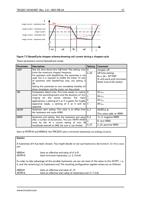
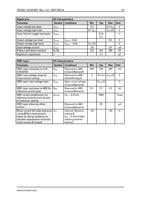
PDN_UART: CONFIGURATION OF STANDSTILL POWER DOWN
PDN_UART
Current Setting
GND
VCC_IO
UART interface
Enable automatic power down in standstill periods
Disable
When using the UART interface, the configuration pin should be disabled via
GCONF.pdn_disable = 1. Program IHOLD as desired for standstill periods.
SPREAD: SELECTION OF CHOPPER MODE
SPREAD
GND or
Pin open / not
available
VCC_IO
Chopper Setting
StealthChop is selected. Automatic switching to SpreadCycle in dependence of
the step frequency can be programmed via OTP.
SpreadCycle operation.
MS1/MS2: CONFIGURATION OF MICROSTEP RESOLUTION FOR STEP INPUT
MS2 MS1 Microstep Setting
GND GND 4 microsteps (quarter step)
GND VCC_IO 8 microsteps
VCC_IO GND 16 microsteps
VCC_IO VCC_IO 32 microsteps
3.5 High Motor Current
When operating at a high motor current, the driver power dissipation due to MOSFET switch on -
resistance significantly heats up the driver. This power dissipation will significantl y heat up t he PCB
cooling infrastructure, if operated at an increased duty cycle. This in turn leads to a further increase of
driver temperature. An increase of temperature by about 100°C increases MOSFET resistance by
roughly 50%. This is a typical behavior of MOSFET switches. Therefore, under high duty cycle, high
load conditions, thermal characteristics have to be carefully taken into account, especially when
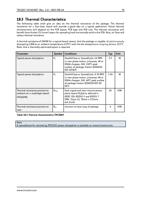
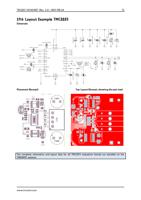
increased environment temperatures are to be supported. Refer the thermal characteristics and the
layout hints for more information. As a thumb rule, thermal properties of t he PCB design become
critical for the HTSSOP28 package at or above 1.2A RMS motor current for increased periods of time.
Keep in mind that resistive power dissipation raises with the square of the motor current. On the
other hand, this means that a small reduction of motor current significantly saves heat dissipation
and energy.
Pay special attention to good thermal properties of your PCB layout, when going for 1 .2A RMS current
or more.
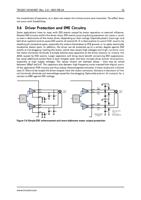
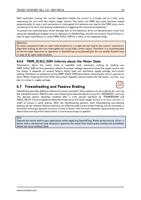
An effect which might be perceived at medium motor velocities and motor sine wave peak currents
above roughly 1.4A peak is a slight sine distortion of the current wave when using SpreadCycle. It
results from an increasing negative impact of parasitic internal diode conduction, which in turn
negatively influences the duration of the fast decay cycle of the SpreadCycle chopper. This is, because
the current measurement does not see the full coil current during this phase of the sine wave,
because an increasing part of the current flows directly from the power MOSFETs’ drain to GND and
does not flow through the sense resistor. This effect with most motors does not negatively influence
www.trinamic.com