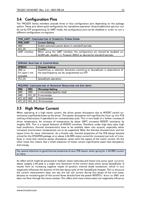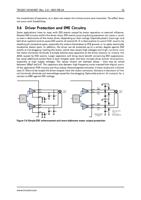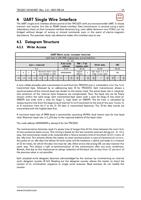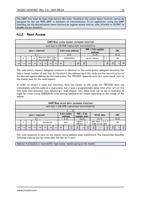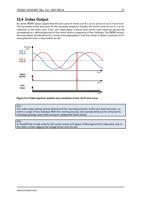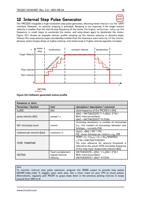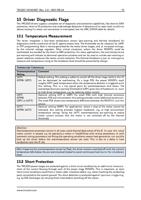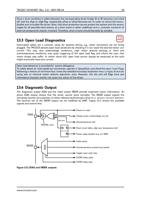






TMC2225 DATASHEET (Rev. 1.15 / 2023-FEB-16)
51
scaling as the internal reference voltage. A voltage between 0V and 2.5V linearly scales the current
between 0 and the current scaling defined by the sense resistor setting. It is not advised to work
with reference voltages below about 0.5V to 1V for full scale, because relative analog noise caused by
digital circuitry and power supply ripple has an increased impact on the chopper precision at low
VREF voltages. For best precision, choose the sense resistors in a way that the desired maximum
current is reached with VREF in the range 2V to 2.4V. Be sure to optimize the cho pper settings for the
normal run current of the motor.
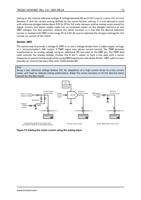
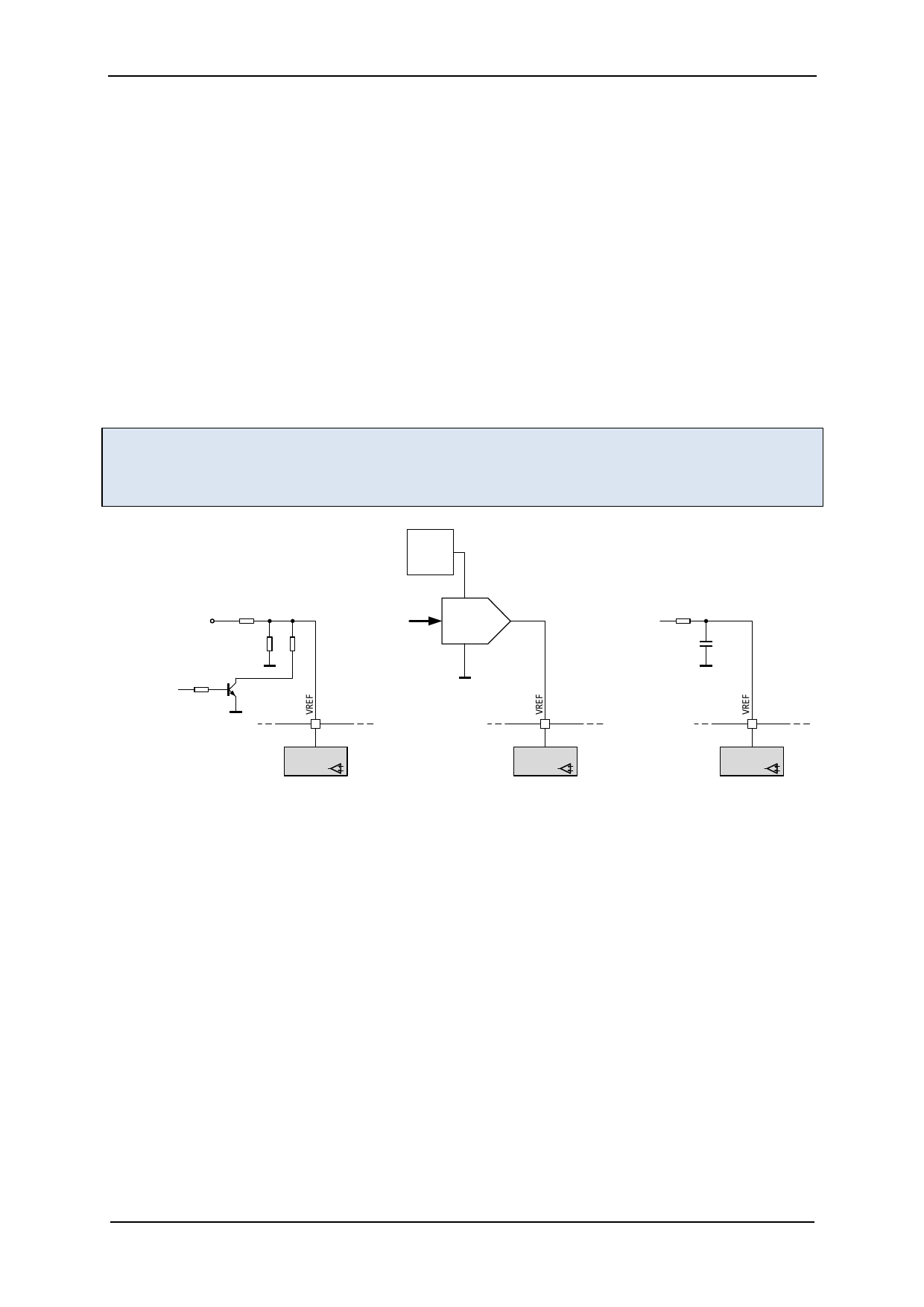
DRIVING VREF
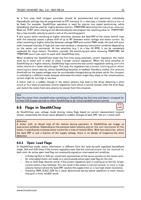
The easiest way to provide a voltage to VREF is to use a voltage divider from a stable supply voltage
or a microcontroller’s DAC output. A PWM signal also allows current control. The PWM becomes
transformed to an analog voltage using an additional R/C low-pass at the VREF pin. The PWM duty
cycle controls the analog voltage. Choose the R and C values to form a low pass with a corner
frequency of several milliseconds while using PWM frequencies well above 10 kHz. VREF additionally
provides an internal low-pass filter with 3.5kHz bandwidth.
Hint
Using a low reference voltage (below 1V), for adaptation of a high current driver to a low current
motor will lead to reduced analog performance. Adapt the sense resistors to fit the desired motor
current for the best result.
2.5V
precision
reference
5VOUT or precise
reference voltage
R1
R1+R2»10K
1-2.4V for fixed
current scaling
R2 R3
Optional
digital
control 100k
BC847
Digital
current
control
8 Bit DAC
0-2.4V for
current scaling
PWM output
of µC with
>20kHz 22k
0-2.4V for
current scaling
1µ
Analog Scaling
Analog Scaling
Fixed resistor divider to set current scale
(use external reference for enhanced precision)
Precision current scaler
Figure 9.1 Scaling the motor current using the analog input
Analog Scaling
Simple PWM based current scaler
www.trinamic.com