



G5PrintSettingsCasestudies20211118
PA6Nylon6, also knownas PA6, polyamide 6, nylon6, is a polymer compound. The chemicalandphysicalpropertiesof nylon 6 are very similar to nylon 66, however, it has a lowermeltingpointanda wide processingtemperature range. Ithas betterimpact anddissolutionresistance than nylon66 plastic, but isalso more hygroscopic. Because manyquality characteristics of plastic parts areaffected by hygroscopicity, itisimportant to take this into account whendesigning products usingnylon6. Inorder to improve the mechanical propertiesofnylon 6, variousmodifiersare oftenadded. Glass fiber isthe most commonadditive, and sometimes syntheticrubber, such as EPDMandSBR, is added to improve impactresistance. For products withoutadditives, the shrinkage of nylon 6 plastic material isbetween 1% and 1.5%. Addingglass fiberadditives canreduce the shrinkage to 0.3% (but slightly higher in the direction perpendicular to the process). The shrinkage ofmoldingassemblyis mainlyaffectedbythe crystallinity and hygroscopicityof the material. Actual shrinkage is alsoa functionof partdesign, wall thickness andotherprocess parameters. Nylon6injectiondrying treatment Since nylon 6 easily absorbs moisture, special attention should be paid to the dryingbefore processing. If the materialissuppliedin waterproof packaging, the containershould be kepttightly closed.If the humidity is greaterthan0.2%, it is recommendedtodry in hot airabove 80°C for16hours.If the materialhasbeen exposedto airfor more than 8 hours, vacuum drying at105°C formore than 8 hours is recommended.
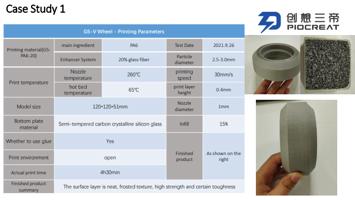
Case Study1G5-V Wheel -Printing ParametersPrinngmaterial(G5-PA6-20)mainingredientPA6TestDate2021.9.26EnhancerSystem20%glassberParclediameter2.5-3.0mmPrint temperatureNozzle temperature260printingspeed30mm/shotbedtemperature65printlayer height0.4mmModel size120*120*51mmNozzlediameter1mmBottom plate materialSemi-tempered carboncrystalline silicon glassInfill15%Whether to use glueYesFinishedproductAsshownontherightPrint environmentopenActualprintme4h30minFinishedproductsummaryThesurface layeris neat, frosted texture,highstrengthandcertain toughness
PSPolystyrene (abbreviated PS)refersto a polymersynthesized by free radical additionpolymerizationof styrene monomer, andthe chemicalformulais (C8H8)n. It is a colorlessand transparentthermoplastic witha glass transitiontemperature higher than 10C, so it is often used to make various disposable containers thatneed to withstandthe temperature of boiling water, aswellas disposable foam lunchboxes. The glass transitiontemperature of polystyrene is 80105℃,the amorphous density is 1.041.06g/cm3, the crystal density is 1.111.12g/cm3, the meltingtemperature is240℃, andthe resistivity is10201022Ω·cm. Thermal conductivity0.116watts/(m·K) at3C.Usually polystyrene isanamorphous random polymer,which has excellentheatinsulation,insulationand transparency.The long-term use temperature is 0-70 °C, butitis brittle andeasy to crack atlowtemperature. There are also isotactic andsyndiotactic andatacticpolystyrene. Isotacticpolymers are highly crystalline, andsyndiotactic polymers are partiallycrystalline.
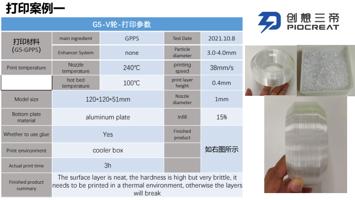
G5-V-G5-GPPSmainingredientGPPSTestDate2021.10.8EnhancerSystemnoneParclediameter3.0-4.0mmPrint temperatureNozzle temperature240printingspeed38mm/shotbedtemperature100℃printlayer height0.4mmModel size120*120*51mmNozzlediameter1mmBottom plate materialaluminum plateInfill15%Whether to use glueYesFinishedproductPrint environmentcoolerboxActualprintme3hFinishedproductsummaryThe surface layer isneat, the hardness ishigh butvery brittle, itneeds to be printedin athermal environment,otherwise the layers willbreak
PPPolypropylene, abbreviatedas PP, is a colorless, odorless, non-toxic, translucentsolidsubstance. Polypropylene isa thermoplastic synthetic resin with excellent properties, whichis a colorless andtranslucent thermoplastic lightweightgeneral-purposeplastic. Ithas chemicalresistance, heatresistance, electricalinsulation, high-strengthmechanical properties andgoodhighwear-resistantprocessingproperties,etc., whichmakes polypropylene rapidly usedin machinery, automobiles, electronicappliances,construction, textiles, packaging since itsinception.It has been widelydeveloped andappliedin many fieldssuchas agriculture, forestry, fishery andfoodindustry. Inrecent years, withthe rapid development of mycountry's packaging, electronics, automobile andother industries, ithas greatly promoted the developmentof my country'sindustry. Andbecause ofits plasticity, polypropylene materials are gradually replacing woodenproducts, and high strength, toughness andhigh wear resistance have graduallyreplaced the mechanical functions of metals. Inaddition, polypropylene has goodgrafting andcompounding functions, and has huge applicationspace in concrete, textile, packagingandagriculture, forestryand fishery.
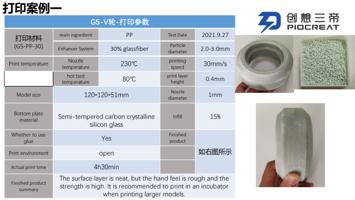
G5-V-(G5-PP-30)mainingredientPPTestDate2021.9.27EnhancerSystem30% glassberParclediameter2.0-3.0mmPrint temperatureNozzle temperature230printingspeed30mm/shotbedtemperature80printlayer height0.4mmModel size120*120*51mmNozzlediameter1mmBottom plate materialSemi-temperedcarbon crystalline siliconglassInfill15%Whether to use glueYesFinishedproductPrint environmentopenActualprintme4h30minFinishedproductsummaryThe surface layer isneat, but the handfeelis rough and thestrengthishigh. Itis recommendedto print inan incubatorwhen printinglargermodels.
TPEThermoplastic elastomer, referredto as TPEor TPR, isthe abbreviationof Thermoplasticrubber. It isa kind ofelastomer thathas the elasticityof rubber at room temperature and canbe plasticizedathightemperature. The structuralfeature of thermoplastic elastomers isthatdifferentresin segments andrubbersegments are composedof chemical bonds. The resin segmentforms physicalcross-linkingpoints by virtue of interchain force, and the rubbersegment isa highly elasticsegmentthat contributes to elasticity. The physicalcrosslinking of the plastic segments isreversible with temperature, showing the plastic processing properties of thermoplasticelastomers. Therefore, thermoplastic elastomerhas the physicaland mechanical properties ofvulcanized rubber andthe processingproperties of thermoplastics. It isa new type ofpolymermaterial betweenrubber andresin,andis oftenreferredto as the third-generation rubber. Thermoplasticelastomer is a new type of polymermaterial between rubberand resin, whichcannotonlyreplace partofrubber,but also modify plastic. Thermoplasticelastomers have the dual properties andbroad characteristics ofrubber andplastic, so thattheyare widely used in the rubberindustryto manufacture rubber shoes, tapes and otherdaily necessities andrubber hoses, tapes, rubber strips, rubbersheets, plasticparts andadhesives, etc. Various industrial supplies. At the same time, thermoplastic elastomers can also be widely usedin the modification of generalthermoplastic resins such as PVC,PE, PP, PS, and even engineering plasticssuch as PU, PA, andCA, insteadof rubber, which has brought a newsituationto the plastics industry.
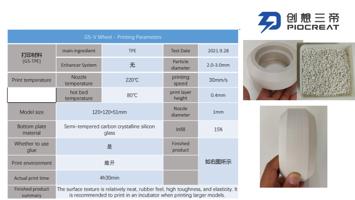
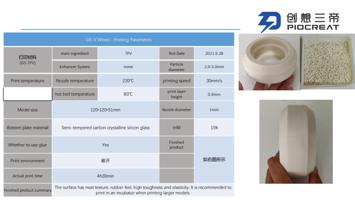
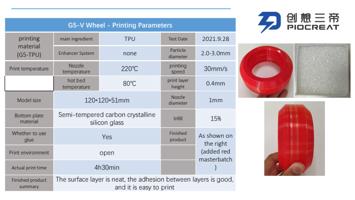
G5-VWheel - PrintingParameters(G5-TPE)mainingredientTPETestDate2021.9.28EnhancerSystemParclediameter2.0-3.0mmPrint temperatureNozzle temperature220printingspeed30mm/shotbedtemperature80printlayer height0.4mmModel size120*120*51mmNozzlediameter1mmBottom plate materialSemi-tempered carboncrystalline siliconglassInfill15%Whether to use glueFinishedproductPrint environmentActualprintme4h30minFinishedproductsummaryThesurface textureis relatively neat, rubberfeel,hightoughness, and elasticity. It isrecommendedto printin an incubator when printing largermodels.
TPVThermoplastic vulcanizate (English as Thermoplastic Vulcanizate), referredto as TPV, thermoplasticvulcanizate inChinese referred to asthermoplastic rubber (EnglishThermoplasticRubber),referredto as TPR, but thisname is easyto be confusedwith othertypes of thermoplasticelastomers (Thermoplastic Elastomer inEnglish) Together, because thermoplastic elastomers are usually calledthermoplastic rubbers, especially styrene elastomers, at least inChina, itseems that "TPR" hasbecome its propername. When itcomes to TPR, it refers to SBS, SEBS, etc.Styrenicelastomersare thermoplastic elastomers as basematerials, whichare inseparable fromthe large consumption ofstyrenic elastomers in the fields of civiland finalconsumer goods. TPV is mainly composed oftwoparts, one is plasticas acontinuous phase, and the otherisrubber asa dispersed phase. Usuallyrubber needs to be combinedwith softeningoil orplasticizer. Vulcanizingagentandsome auxiliaryadditives are also essential. Inaddition, some inorganic fillerswill be added in orderto reduce costs orimprove performance in certainaspects.
    "